
Moving blockchain infrastructure can feel like performing surgery on a moving vehicle. Developers work with live applications, live users, and transactions that can’t fail.
However, as initiatives expand, they ultimately come to the point when existing configurations fail to match the requirements. Peak hour latency becomes the standard, and infrastructure maintenance costs deplete money faster than anticipated.
Migration should not be intimidating. Numerous project owners migrate their entire infrastructure during weekends seamlessly without making the user realize the change.
Current statistics indicate that roughly 68% of blockchain projects experience at least one significant infrastructure snag during the initial year. The majority of such issues have their roots in poor-quality blockchain nodes or badly carried out migrations.
Move to Instanodes today and experience zero-downtime migration of your blockchain infrastructure.
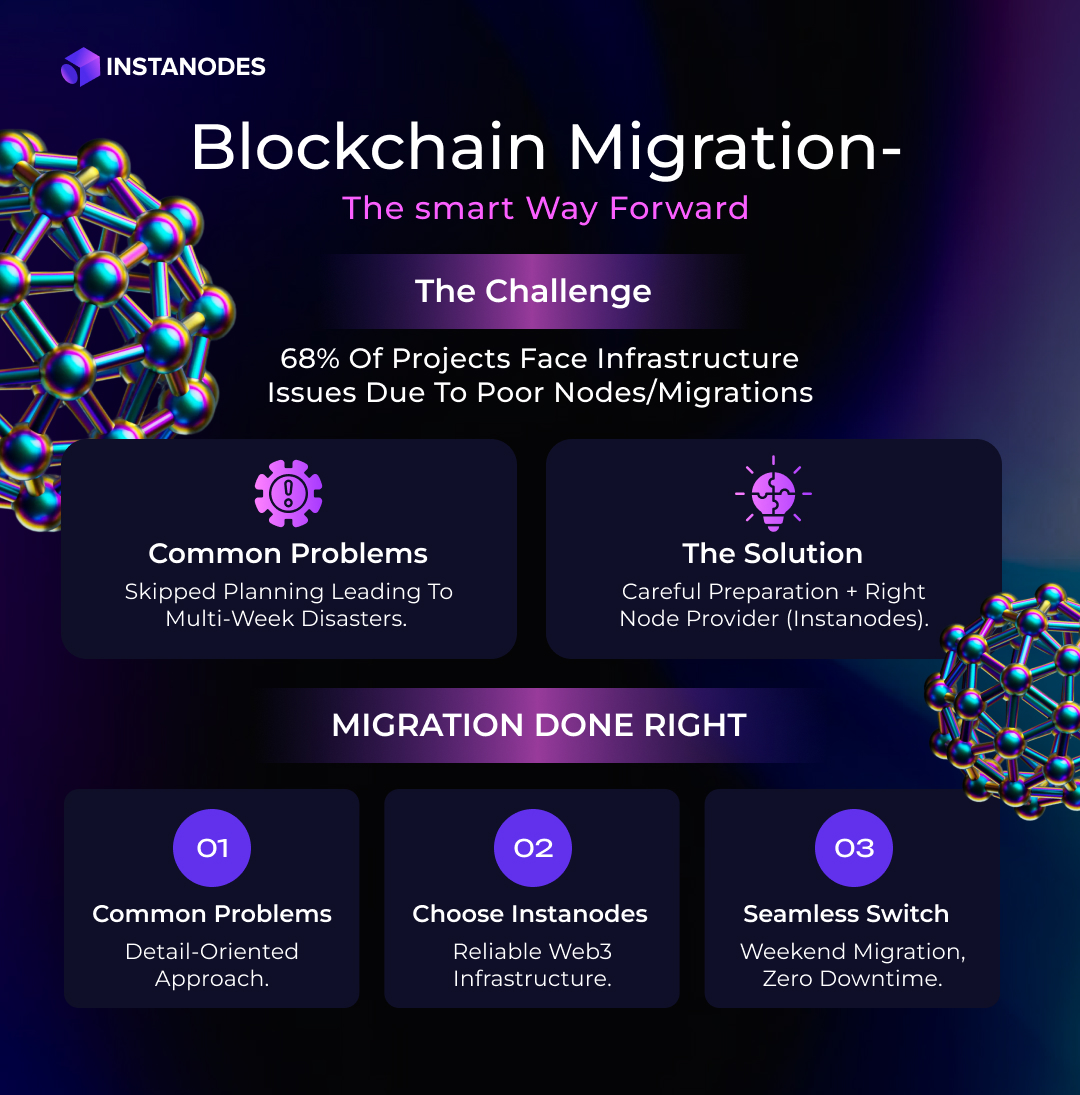
Others witness migrations that turn into multi-week disasters because someone skipped the planning phase. What makes the difference in outcomes is doing careful preparation and having the right Web3 node provider backing the effort.
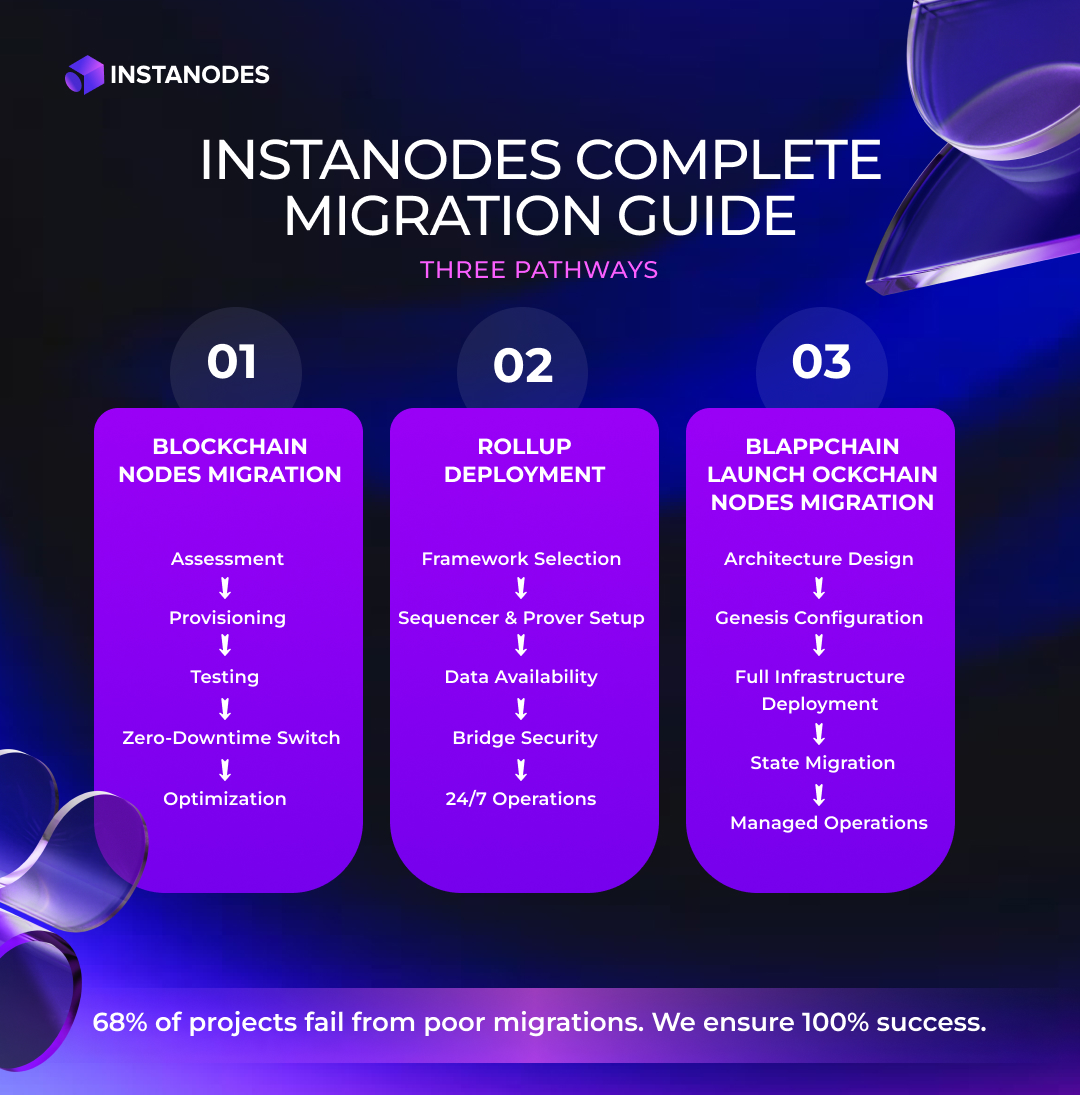
This guide walks you through moving to Instanodes before launch day. Here, everything related to simple blockchain nodes migration to the more intricate realm of blockchain Rollups and Appchains is addressed. From migrating in place versus building absolutely new from scratch, these approaches avoid the typical pitfalls that ensnare most developers. The process of migration requires close attention to detail, but the return in terms of reliability and performance makes it well worth the effort for any serious Web3 project.
Seamless Node Migration: Move Your Infrastructure Without Missing a Block
Running blockchain nodes uninterrupted without losing a single block is paramount when processing financial transactions or fueling DeFi protocols. Even temporary downtime means lost revenue and angry users. Bad node infrastructure is responsible for most service issues that afflict blockchain applications, so selecting a Web3 node provider is one of the single most significant technical choices any project will make.
With Instanodes managing the migration, your team can transition the entire infrastructure while users continue trading and transacting without interruption. The process needs coordination and planning, but Instanodes handles all technical execution, eliminating the risks that typically come with infrastructure migrations.

Step 1: Assessment and Migration Planning
Understanding the current setup comes first. Share details about current blockchain nodes with the Instanodes team. Mention which networks are being accessed, what request volumes look like, and any special requirements. The information doesn’t need to be technically detailed. Instanodes asks the right questions to understand the full picture.
Our experts analyzes the application architecture to identify all integration points. They map out which applications make API calls, what services use WebSocket connections, and what dependencies exist on the node infrastructure. This mapping ensures the new setup supports everything currently in place.
Instanodes establishes performance baselines by measuring typical response times, query throughput, and uptime statistics. These metrics prove the new infrastructure delivers real improvements.
A migration timeline gets created that outlines the phases, estimates time requirements, identifies optimal timing to minimize user impact, and establishes rollback procedures if needed. The timeline balances thorough testing with business constraints around launch dates or peak usage periods.
Step 2: Instanodes Provisions New Infrastructure
Instanodes deploys blockchain nodes optimized for specific networks and use cases. The team selects appropriate node types, archive nodes for complete historical data, full nodes for standard operations, or optimized configurations for specific query patterns. Hardware gets chosen to handle the current load with significant room for growth.
Nodes get distributed across multiple data centers to minimize latency for target users. This distribution provides redundancy. If one location has issues, other nodes keep serving traffic seamlessly.
We configure complete API infrastructure, including load-balanced RPC endpoints, caching layers for common queries, rate limiting and DDoS protection, and WebSocket connections for real-time events. All endpoints come with monitoring and automatic failover built in.
While new blockchain nodes sync with their networks, Instanodes monitors the process. Syncing can take hours or days, depending on the chain, but our team ensures everything completes successfully before routing any production traffic.
Enterprise-grade monitoring tracks block height, peer connectivity, memory usage, API response times, and system resources. Automated notification alarms the operations team instantly if something appears amiss.
Step 3: Testing and Validation
Before touching production, Instanodes conducts extensive testing. Test applications get pointed at the new infrastructure while production continues on existing nodes. This parallel operation allows real-world validation without risking service disruption.
Load testing simulates production traffic and beyond, typical volumes, peak scenarios, and sustained high-volume operations. The infrastructure should handle everything comfortably with capacity for future growth.
Failover gets tested by deliberately taking nodes offline to verify traffic automatically routes to healthy nodes, measuring failover speed, and confirming applications handle transitions smoothly. These controlled tests ensure the infrastructure stays resilient under adverse conditions.
Integration testing validates that transaction submissions succeed, event streaming delivers updates reliably, historical queries return accurate results, and custom integrations function as expected. Any issues get resolved during this phase.
Step 4: Zero-Downtime Migration
When testing confirms everything works, Instanodes executes the migration using strategies that eliminate downtime risks.
Traffic migration happens gradually. Instanodes starts with just 5% of production traffic routed to new infrastructure while carefully monitoring performance and error rates. This catches any problems while they only impact a minority of traffic.
The team gradually raises traffic before relying on the new infrastructure completely. In each step, we check for stability before going on. If issues emerge, traffic can instantly route back to the previous infrastructure without user impact.
The old infrastructure stays fully operational until migration proves stable. This safety net means the migration can proceed confidently with an escape hatch if unexpected problems arise.
You receive regular updates throughout, but don’t manage any technical execution. Instanodes handles all orchestration, monitoring, and decision-making while keeping stakeholders informed.
Step 5: Optimization and Ongoing Support
After migration, Instanodes continues intensive monitoring and optimization. The first 72 hours receive special attention as this window reveals issues that only appear at full production scale. The team watches for performance anomalies, validates data consistency, monitors resource trends, and addresses any concerns immediately.
Performance optimization happens based on real usage patterns. Our team analyzes query patterns for optimization opportunities, adjusts caching strategies, tunes resource allocations, and implements configuration refinements. These optimizations continue as the team learns from production traffic.
Instanodes provides 24/7 monitoring and operations for all blockchain nodes going forward. The operations team continuously watches node health, manages software updates and security patches, handles scaling as traffic grows, and resolves issues proactively before they impact applications.
Performance optimization continues as applications evolve. The team monitors changing usage patterns, adjusts infrastructure to match new requirements, and implements best practices. Being a trusted and experienced Web3 node provider, we ensure that your infrastructure scales with business growth.
Security updates happen automatically. When blockchain software releases updates, Instanodes tests them thoroughly, coordinates deployment to avoid disruption, applies updates across all nodes, and verifies completion. Applications always run current, secure software without managing update processes.
This managed approach transforms blockchain node infrastructure from a technical burden into a reliable service. Teams focus entirely on building applications and growing user bases while Instanodes ensures the underlying infrastructure remains fast, reliable, and secure.
Transition your rollups, Appchains, and nodes to Instanodes for unmatched reliability and uptime.
Deploying Your Rollup on Instanodes for Scalable Layer 2 Performance
Blockchain Rollups are now the de facto solution for scaling blockchain applications without compromising security. These Layer 2 solutions execute transactions off-chain while retaining Layer 1 security promises, allowing applications to process thousands of transactions per second for a fraction of the price.
Deploying blockchain Rollups the old way, though, means each of the several specialized elements, including sequencers, provers, data availability layers, and bridges. All necessitating extensive technical knowledge.
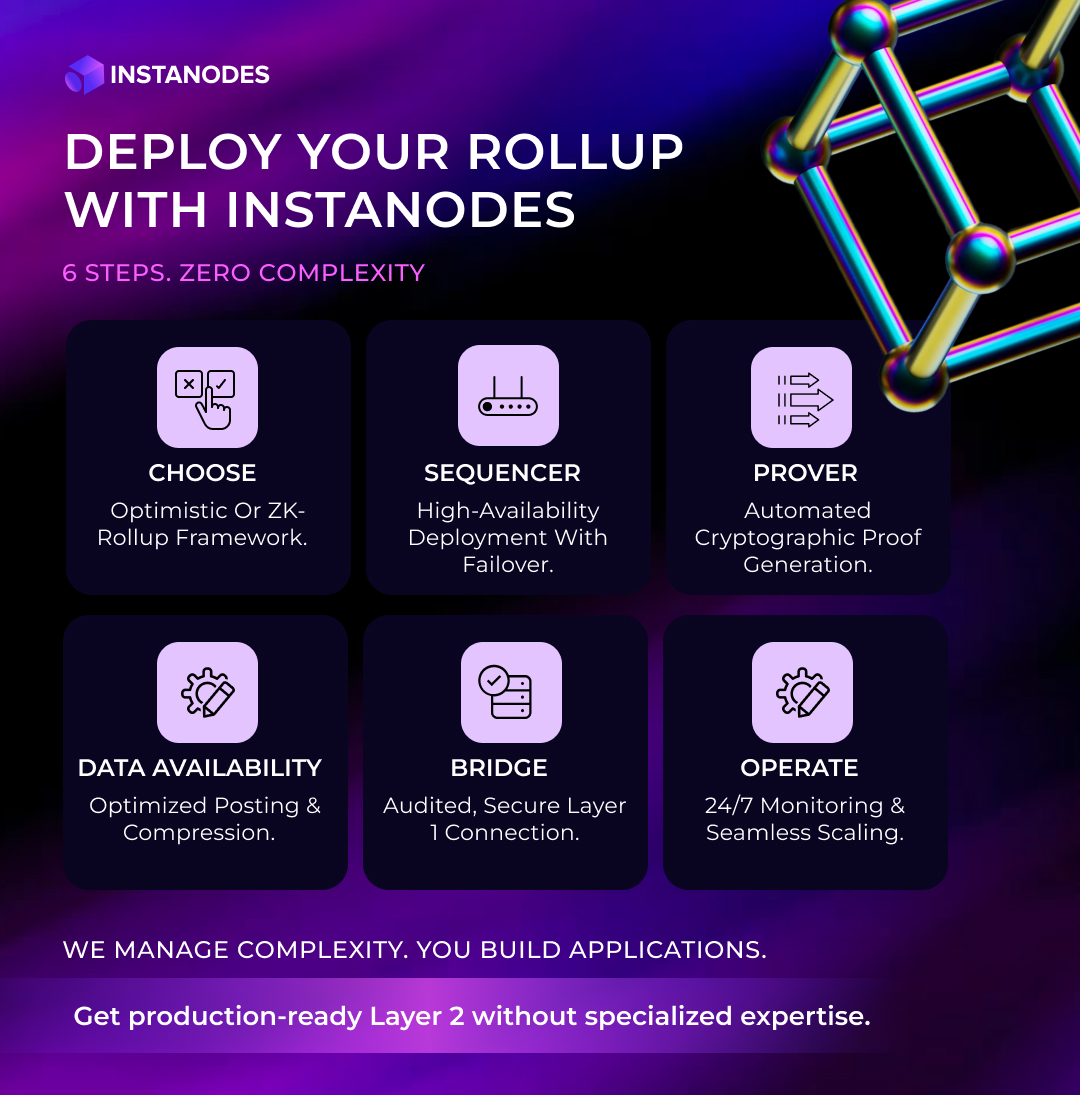
Instanodes removes this complexity by offering managed Rollup infrastructure. Teams can deploy production-ready blockchain Rollups without having to develop internal experience in sequencer operations, bridge security, or prover administration. Instanodes manages all provisioning of infrastructure, configuration, and ongoing operational activities, so teams can concentrate on application development and user acquisition.
Step 1: Choose Your Rollup Framework and Architecture
The initial step is choosing the most appropriate Rollup type based on application needs and end-user requirements.
Optimistic Rollups, such as Arbitrum and Optimism, default to assuming transactions are valid, employing a challenge time for security. They have great EVM compatibility, which makes them great for applications that need to take advantage of available Ethereum tooling and port Solidity contracts simply. The compromise comes with longer times for withdrawals, usually seven days, because of the fraud-proof challenge window.
Applications that can tolerate this withdrawal delay benefit from simpler implementation and stronger Ethereum compatibility.
ZK-Rollups like zkSync and StarkNet use cryptographic proofs to guarantee transaction validity immediately. They provide faster finality and quicker withdrawals since validity is mathematically proven rather than optimistically assumed. It has greater computational overhead for proof construction, and being fully EVM-compatible is more complicated. Applications that value quick finality and prompt withdrawals tend to favor ZK-Rollups even with the added complexity.
Discuss specific application requirements with the Instanodes team. Share expected transaction volumes, target user base size, required transaction finality times, and budget considerations. Instanodes provides recommendations based on these requirements and experience deploying similar blockchain Rollups across various use cases.
Look at the developer ecosystem and tooling available. Optimistic Rollups already have more advanced developer tools and greater smart contract compatibility available today. ZK-Rollups are rapidly advancing but may require additional development effort for complex applications. Instanodes helps evaluate these tradeoffs based on the specific technical stack and team capabilities.
Define economic parameters for the Rollup, including transaction fee structures, gas price policies, and sequencer revenue models. Instanodes provides consultation on sustainable economic designs that balance user affordability with operational costs.
Step 2: Let Instanodes Deploy Your Sequencer Infrastructure
The sequencer represents the heart of any Rollup, responsible for ordering transactions, producing blocks, and serving as the primary user interface. Instanodes handles all sequencer deployment and management.
Instanodes provisions redundant sequencer nodes configured for high availability. Sequencers run in parallel with failover, so if the main sequencer is having problems, backup sequencers will switch over in seconds. Users never experience service interruptions due to sequencer problems.
The Instanodes team configures optimal sequencer parameters based on the chosen Rollup framework and application requirements. This includes setting appropriate block times that balance user experience with batching efficiency, configuring gas limits that maximize throughput while preventing abuse, establishing transaction batching parameters that optimize Layer 1 posting costs, and implementing mempool management policies that ensure fair transaction ordering.
Instanodes deploys comprehensive monitoring specifically for sequencer operations. The system tracks block production rates to ensure consistent performance, monitors transaction pool sizes to detect congestion early, watches for reorgs that might indicate issues, and measures peer connectivity to maintain network health. Automated alerts notify the Instanodes operations team of any anomalies requiring attention.
Load testing happens before the Rollup goes live. Instanodes simulates production traffic levels and beyond, ensuring sequencers handle expected transaction volumes comfortably with significant headroom for growth. Stress testing reveals bottlenecks before the end users find them.
Customers get out-of-the-box RPC endpoints to send transactions to a sequencer. These endpoints include auto-load balancing, DDoS prevention, and geographic distribution for the best possible worldwide performance. Applications just reference supplied endpoints without concern for back-end sequencer infrastructure.
Step 3: Instanodes Manages Prover Infrastructure
Provers generate the cryptographic evidence that makes blockchain Rollups secure, handling computationally intensive work that requires specialized infrastructure. Instanodes takes complete responsibility for prover operations.
For ZK-Rollups, Instanodes provisions high-performance compute infrastructure optimized for proof generation. This often includes GPU-accelerated servers or specialized hardware, depending on the specific Rollup framework. Proof generation capacity scales automatically to keep pace with sequencer output, preventing backlogs that would slow transaction finality.
For Optimistic Rollups, Instanodes operates fraud-proof challengers that monitor every state transition posted to Layer 1. These challengers watch for invalid state roots and automatically submit challenges if suspicious activity is detected. The system operates continuously, ensuring the Rollup remains secure through the challenge period mechanism.
Instanodes implements intelligent proof batching strategies that optimize the tradeoff between proof generation costs and transaction finality times. The system adaptively varies batching depending on the volume of transactions, network load, and gas prices in order to reduce fees while preserving suitable finality for users.
Proof generation performance is monitored on an ongoing basis by monitoring systems. Instanodes monitors proof generation times against targets, queues for backlogs, success rates to detect systemic problems, and measures resource utilization in order to best allocate infrastructure.
You will never have to comprehend the technicalities of fraud-proof systems or zero-knowledge proofs. Instanodes ensures proofs are generated efficiently and reliably, maintaining the security guarantees that make blockchain Rollups valuable.
Step 4: Instanodes Implements Data Availability Solutions
Transaction data must be available for verification, and the chosen data availability strategy significantly impacts both security and operational costs. Instanodes manages this critical infrastructure component.
Instanodes implements the most appropriate data availability solution based on the Rollup design and security requirements. For maximum security, transaction data gets posted to Layer 1, guaranteeing availability as long as Ethereum exists. For cost optimization, Instanodes can implement alternative approaches like data availability committees or emerging solutions like Celestia, while clearly communicating the associated tradeoffs.
The team configures data posting with optimal batching strategies that balance costs against data availability guarantees. Transaction data is compressed efficiently before posting to minimize Layer 1 costs, which often represent the largest operational expense for blockchain Rollups.
Redundancy is built into the data availability infrastructure regardless of the chosen approach. If using on-chain data availability, multiple archive nodes maintain complete historical data. If using off-chain solutions, Instanodes eliminates single points of failure through geographic distribution and multiple data availability partners.
Monitoring ensures data remains consistently available. Instanodes verifies that all required data gets posted successfully, validates that historical data remains retrievable for state reconstruction, and tracks data availability costs to identify optimization opportunities.
You benefit from professionally managed data availability without needing to understand the underlying technical and economic tradeoffs. Instanodes handles implementation details while ensuring the Rollup maintains appropriate security guarantees.
Step 6: Launch and Ongoing Operations
After deployment, Instanodes provides comprehensive managed operations that keep blockchain Rollups running optimally while you focus entirely on your applications.
Instanodes operates 24/7 monitoring across all Rollups components. The operations team watches sequencer performance and health, prover efficiency and queue status, data availability posting success, bridge security and liquidity, and overall network performance metrics. Issues get identified and resolved proactively before they impact users.
Network upgrades and maintenance happen seamlessly. When Rollup framework updates are released, Instanodes tests them thoroughly in isolated environments, coordinates upgrade timing to minimize user impact, executes upgrades with zero or minimal downtime, and verifies all components function correctly post-upgrade. Clients receive notifications about improvements, but perform no technical work.
Performance optimization is continuous. Instanodes analyzes transaction patterns to identify bottlenecks, adjusts infrastructure resources to match demand, tunes configuration parameters for optimal throughput, and implements architectural improvements as the Rollup scales. Performance enhancements happen automatically as the operations team refines the infrastructure.
Comprehensive reporting provides visibility into Rollup performance. You receive regular updates on transaction volumes and growth trends, Layer 1 posting costs and optimization opportunities, bridge activity and liquidity status, as well as overall network health metrics. These insights inform business decisions without requiring infrastructure expertise.
Security monitoring remains an ongoing priority. Instanodes watches for emerging threats or attack vectors, implements security patches and updates promptly, coordinates with security researchers and auditors, and maintains incident response readiness.
As applications grow, Instanodes scales the Rollup infrastructure seamlessly. The team monitors capacity utilization, provisions additional resources before constraints appear, optimizes network topology for performance, and implements architectural improvements as needed. Scaling happens transparently without your intervention.
This fully managed approach allows you to deploy sophisticated blockchain Rollups without building specialized Layer 2 expertise. Instanodes handles everything from sequencer operations to bridge security, letting clients concentrate on building great applications. The complexity of running production Rollup infrastructure becomes Instanodes’ responsibility, not your burden.
Appchain Launch Checklist: Building and Migrating Your Custom Blockchain with Instanodes
An Appchain offers specialized blockchain infrastructure specifically to meet the needs of particular applications. Unlike being deployed upon shared networks, an Appchain gives total control of consensus protocols, transaction fee arrangements, governance systems, and performance metrics. Such customization allows applications to tune each detail of their blockchain environment, achieving better performance while keeping the security and decentralization that make blockchain worth using.
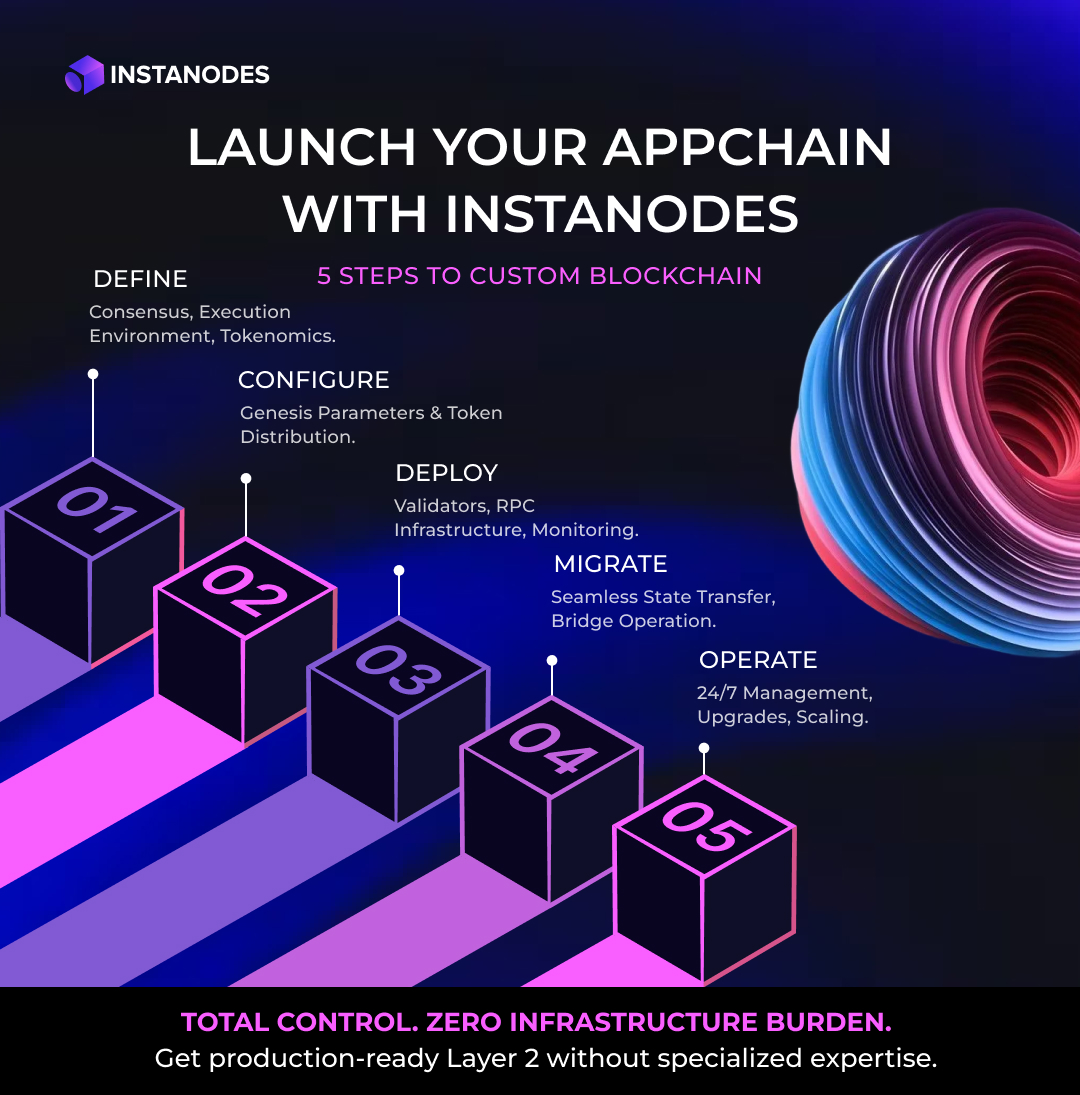
Developing and moving to an Appchain via Instanodes simplifies what would normally be a daunting technical undertaking into an efficient, managed process. Instanodes takes care of the intricate infrastructure configuration, validator coordination, and operational maintenance, so you can concentrate solely on developing your application and growing your business.
Step 1: Define Appchain Architecture and Requirements
The initial step is to make basic architectural choices that will still determine the network’s capabilities throughout its lifetime.
Choose the right consensus mechanism for the use case. Proof of Stake variations provide excellent decentralization with decent performance and are thus ideal for applications that need widespread validator participation. Delegated Proof of Stake offers much better throughput by restricting consensus to voted validators and is thus ideal for applications that value speed. Proof of Authority achieves the best performance via trusted validators and is ideal for enterprise use cases.
Select the execution environment based on the requirements of developer ecosystems. EVM compatibility enables developers to utilize existing Solidity tools and contracts unchanged, significantly lowering development time. Other environments such as WebAssembly provide performance benefits but do call for specialized tooling and developer training.
Work with the Instanodes team to come up with network specifications. Discuss expected transaction volumes, user base size, geographic distribution requirements, and growth projections. Instanodes translates these business requirements into technical specifications without requiring deep blockchain expertise from the client side.
Define the token economic model carefully, establishing total token supply, initial distribution, inflation schedule, and transaction fee structures. Instanodes provides consultation on sustainable tokenomics based on experience with successful Appchain deployments.
Step 2: Configure Genesis Parameters and Token Distribution
The genesis block establishes the initial state of the Appchain, setting the foundation for everything that follows.
Work with Instanodes to configure core network parameters, including block time, block size limits, gas price floors, and transaction throughput targets. Our experts suggest best-practice start-up values tailored to the particular use case and established configurations of comparable deployments.
Establish the early token distribution, issuing tokens to the founding team, investors, ecosystem development fund, and validator rewards pool. Use vesting schedules for significant allocations to keep from enabling market manipulation. Instanodes helps structure these distributions in accordance with best practices witnessed throughout successful blockchain launches.
Define critical system contracts required from genesis, such as staking contracts, governance contracts, and bridge contracts, in the case of supporting interoperability. We deploy and audit these system contracts so they are up to security standards before launch.
Review the complete Genesis configuration with the Instanodes team, who validate that all parameters align with stated goals and follow best practices. Once approved, Instanodes prepares the genesis file that will initialize the Appchain.
Step 3: Let Instanodes Deploy Your Complete Infrastructure
Once architecture and genesis configuration are finalized, Instanodes handles the entire infrastructure deployment process without requiring any technical input from you.
Instanodes provisions and configures all validator nodes required for the Appchain. The team selects appropriate hardware specifications, provisions servers in geographically distributed data centers, and installs necessary blockchain software. All validator setup happens behind the scenes.
The Instanodes team establishes the complete validator network by configuring cryptographic keys using hardware security modules, setting up secure networking between validator nodes, and initializing each validator with the approved genesis configuration. Validators automatically peer with each other and begin producing blocks once the genesis time arrives.
Instanodes deploys a comprehensive RPC and API infrastructure for application interaction. This encompasses load-balanced RPC endpoints spanning several geographic locations, caching layers for high performance, rate limiting and DDoS defense, and WebSocket connections to support real-time events. You are provided with API endpoints ready to use without having to comprehend underlying infrastructure complexity.
Our team applies enterprise-level monitoring throughout the Appchain network, monitoring validator uptime, transaction volume, network connectivity, and API performance. Automated alerting mechanisms inform Instanodes operations instantly in case of anomalies.
Instanodes deploys necessary ecosystem infrastructure such as block explorers, testnet token faucets, and bridge infrastructure if cross-chain transfers are supported. Everything is integrated, tested, and running when launching. You get a full, production-ready Appchain without handling any infrastructure setup.
Step 4: Execute Seamless Migration from Existing Infrastructure
For migrations of existing applications to their new Appchain, Instanodes orchestrates the complete migration process to maintain data integrity and service continuity.
Our team starts with the examination of existing infrastructure and application structure, grasping what blockchain nodes are being utilized, what needs to be migrated, what smart contracts are in deployment, and what the dependencies are.
The Instanodes team takes a snapshot of the state of the blockchain as it stands today, including all account balances, smart contract code and storage, token holdings, and app-specific data. They manage everything technical with established tools and best practices.
Instanodes imports the captured state into the new Appchain and validates that every account balance matches, all smart contract code is transferred correctly, and no data corruption occurred. Extensive automated testing verifies that applications function identically on the new Appchain.
If phased migration is preferred, Instanodes deploys and operates bridge infrastructure connecting the original chain to the new Appchain. Users can migrate gradually at their own pace while Instanodes handles bridge operation, security monitoring, and liquidity management.
Instanodes coordinates the migration timeline and communications, notifying users about schedules, providing migration tools, offering technical support, and monitoring progress. You simply communicate with your users while Instanodes ensures the infrastructure transition happens smoothly.
Throughout migration, Instanodes maintains parallel infrastructure, keeping both original blockchain nodes and the new Appchain fully operational. Our team monitors both environments and ensures data consistency until migration completes.
Step 5: Benefit from Ongoing Managed Operations
After launch, we continue providing comprehensive managed services that keep the network running optimally while clients focus on their business.
Our team provides 24/7 monitoring and incident management for the overall Appchain infrastructure. The ops team monitors all validator nodes, monitors network health metrics, keeps an eye on API endpoints, and processes transaction patterns. Problems are addressed in real-time without needing your intervention.
All network upgrades and maintenance are taken care of by our team. Upon the release of blockchain software updates, we thoroughly test, schedule upgrade time, perform with minimal downtime, and ensure proper post-upgrade functionality. You get notified but you don’t have to do any technical work.
Instanodes takes care of validator set management as the Appchain scale-up, adding more validators for better decentralization, checking performance, engaging in governance, and applying approved parameter changes.
Our operations team constantly fine-tunes Appchain performance according to usage patterns, monitoring transactions for bottlenecks, resizing infrastructure resources to fit demand, and applying optimization techniques. Improvements to performance occur automatically.
Our team offers in-depth reporting of transaction volumes, network uptime, API usage metrics, and validator performance. These metrics inform business decisions without the need for infrastructure skills.
Security monitoring and incident response are continuing Instanodes tasks, such as watching for threats, applying security patches, reacting to vulnerabilities, and coordinating with security researchers.
As applications increase, Instanodes scales infrastructure effortlessly by monitoring capacity usage, pre-emptively provisioning extra resources, and fine-tuning network topology for peak performance. Scaling occurs invisibly without service interruption.
This end-to-end managed solution enables you to deploy and run advanced Appchains without establishing in-house blockchain infrastructure expertise. We do it all from setup through regular operations, freeing you to focus solely on developing excellent apps and expanding your user base.
Conclusion
Moving to better infrastructure or launching something entirely new always feels daunting at first. All the elements must be combined just right, all of the things that might go awry must be considered, and one wonders if perhaps everything’s been weighed. That’s a good attitude.
Successful developers aren’t necessarily the most technologically adept or cash-rich. They are the ones who carefully plan, proceed cautiously, and don’t cut corners on tedious activities such as testing and monitoring. They are the ones who select a Web3 node provider they can actually call anytime when things go haywire.
When we peek into the blockchain world, we see how rapidly it has changed. A few years ago, blockchain Rollups were considered an experimental technology, but now they process billions of transactions. At the same time, Appchains enable use cases that would have been impossible on shared infrastructure. For anything being developed on the blockchain, you need a reliable infrastructure with no security or speed issues.
Whether relocating current blockchain nodes to more stable hardware, launching state-of-the-art blockchain Rollups to enable application scaling, or spinning up an Appchain that is tailored exactly to particular requirements, the principles remain constant. Make a plan before proceeding, test with great care and perseverance, move incrementally, and obsessively monitor. These tenets hold true, irrespective of the sophistication level.
Instanodes understands this reality. Enough migrations and launches have been completed to know where things usually go wrong and how to prevent those problems. Understanding that infrastructure needs to just work, not be another thing getting troubleshooted when features should be getting built, makes all the difference.
Ready to start the migration or launch the project? Talk to the Instanodes team about specific situations. We’ll review the current setup, identify potential issues, and design a migration plan that fits the timeline and risk tolerance. Start planning today!