Have you ever seen a transaction hang in limbo while gas costs are being drained from your wallet? Or attempted to view your NFT holdings only to be left gazing at a spinning loading wheel? How about when your DeFi app crashes at the exact moment the market begins to move?
These are more than just annoying UX issues, they are symptoms of a larger problem that is currently ailing the Web3 infrastructure. At the root of every hung interface and failed transaction is a problem that flies in the face of everything that blockchain technology stands for, and that is the single point of failure.
Leveraging blockchain doesn’t necessarily mean that your dApp will always show the reliability any Web3 application is expected to provide. It can fail in the most centralized manner possible, and that too through its association with the network. If it is connected with the network through a single node, then everything is vulnerable.
The statistics are alarming. Studies have revealed that blockchain apps have an average of 14 hours of downtime every year. This is equivalent to 95% uptime. This is quite good until you are the one on the receiving end. Every hour of downtime translates to a loss of $300,000 for businesses. This is not just a loss of money for DeFi apps that handle millions of dollars in assets; it is also a loss of reputation and competitive advantage.
Do you know, there is an even larger irony at work? The blockchain networks themselves operate at an incredible level of uptime. Bitcoin has been at 99.98% uptime since 2013. Ethereum networks rarely go down. And yet the applications running on these highly available networks often fail, hang, or slow to a crawl.
Why? It’s because somewhere between the blockchain network and the end user’s screen is a crucial point of failure, and is the node infrastructure. Most Web3 applications communicate with blockchain nodes, and it is how these applications handle this communication makes the difference between an application that is virtually bulletproof and one that fails under pressure. The difference between 95% uptime and 99.99% uptime is not a technical nicety; it’s the difference between 18 days of downtime per year and 52 minutes.
Real-time failover is turning this dynamic on its head. Modern Node as a Service platforms are finally delivering the uptime Web3 applications need by treating node infrastructure with the same distributed philosophy that makes blockchains reliable.
Let’s understand what actually breaks when nodes fail, and why traditional approaches fall short.
Why Node Downtime Breaks Web3?
The Web3 app and blockchain node relationship is surprisingly simple. An app needs data, and it queries a node. User wants to transact? The app submits through a node. Behind this simplicity lurks a dependency that can make or break entire platforms.
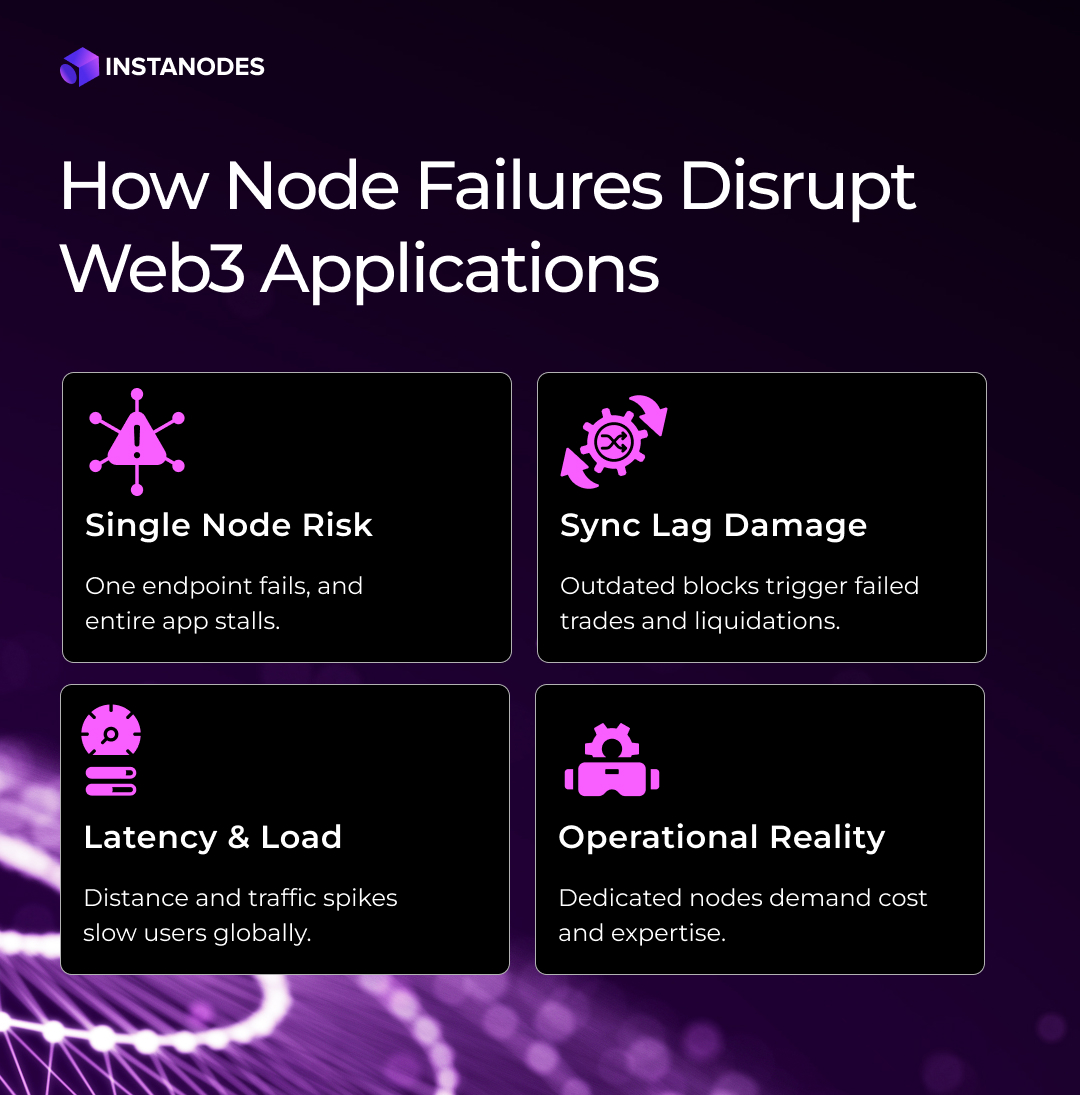
When Single Nodes Create Single Points of Failure
Here’s the pattern that plays out across countless projects: A development team spins up their first dApp, finds a Web3 node provider, grabs an API endpoint, hardcodes it into their application, and ships to production. Everything works during testing. Early users don’t notice issues. Then reality hits.
Nodes crash, network connections drop, hard drives fill up, and updates require restarts. Hosting providers have outages. Any of these scenarios can take a node offline, and when that node is the only bridge between an application and the blockchain, the application goes down with it.
Smart contract calls time out. Transaction submissions return cryptic errors. User balances won’t load. The app isn’t necessarily broken, but it’s dead. Users don’t care about the difference, they just know it’s not working, and most won’t stick around to see if it fixes itself.
Synchronization Lag Breaks Real-Time Applications
A blockchain node that’s running but out of sync is worse than one that’s obviously down. It returns wrong answers while appearing functional.
Blockchain nodes function by downloading and validating every block since the beginning. For Ethereum, this is in excess of 18 million blocks. To stay in sync, a node must download new blocks and reach consensus. Fall behind by even a few blocks, and the node’s view of reality diverges from actual blockchain state.
Consider a DEX interface showing token prices. If the node lags 10 blocks behind, those prices are stale. A user might attempt a swap based on outdated information, only to have their transaction fail at an unexpected rate. For lending protocols, stale data could show positions as healthy when they’re actually liquidatable.
The synchronization challenge intensifies during high network activity. When Ethereum is handling large volumes of transactions, such as during large NFT drops or times of market volatility, nodes that do not have the resources to handle the traffic struggle to keep up. A node that lags during peak times is useless precisely when the application needs it most.
Geography and Capacity Create Performance Penalties
Network latency obeys physics. A request from Singapore to a node in Virginia takes 200-300 milliseconds just for the round trip. Applications where responsiveness matters are gaming dApps, trading interfaces, and even NFT marketplaces. User experience significantly degrades due to geographical penalties.
Most blockchain node providers concentrate infrastructure in major US and European data centers. This results in a suboptimal experience for users in Asia, South America, Africa, and other regions. As the adoption of Web3 continues to grow around the world, regional latency becomes a differentiator.
Besides geography, blockchain nodes are bound with limited resources. When a node is well-provisioned, it can handle 1,000 requests per second with ease, but when that number exceeds, requests starts queuing up, response times increase, and eventually the node starts rejecting connections.
The traffic patterns in Web3 are notoriously spiky. A project may be serving 100 users one day and 10,000 the next due to a viral tweet. An NFT drop sells out in minutes. Applications need infrastructure that scales with these unpredictable surges.
Running dedicated blockchain nodes sounds appealing, as it provides full control, with no shared resources. However, reality is messier:
- 12+ TB of NVMe storage for an Ethereum archive node.
- 32+ GB RAM minimum.
- High-bandwidth network connection.
- 24/7 monitoring and maintenance.
- Specialized expertise in node operations.
Multiply those requirements across multiple chains and redundant instances, and infrastructure bills run into six figures annually. For most teams, this reality is why Node as a Service platforms exist. They solve a genuine problem.
Stop downtime before it starts with real-time failover for blockchain nodes by Instanodes.
Keep blockchain nodes online 24/7 using Instanodes real-time failover infrastructure built for scale.
How Distributed Nodes and Failover Transform Blockchain Uptime from 95% to 99.99%?
There is a clear difference between four nines and two nines. Similarly, you can’t match 99.99% uptime with 95% uptime. It’s like 18 days of downtime per year versus 52 minutes. 18 days For platforms handling financial transactions or time-sensitive operations, those 18 days aren’t abstract statistics; they’re periods when revenue stops and users churn.
How Distributed Architecture Eliminates Failure Points
Modern Node as a Service platforms approach reliability through distribution. Rather than directing traffic to a point of connection, they have networks of blockchain nodes distributed across continents, data centers, and infrastructure companies.
The architecture includes:
- Nodes in North America, Europe, Asia-Pacific, and emerging markets.
- Infrastructure across multiple cloud and dedicated providers.
- Independent operation without shared dependencies.
- Network redundancy with multiple backbone connections.
When an application makes a request of the distributed network, the request goes to any of the healthy nodes in the pool. Companies that have moved from single nodes to distributed Node as a Service platforms have seen their uptime increase from around 95% to 99.97% or better, representing 95% fewer hours of downtime.
Geographic Distribution Solves the Latency Problem
A Web3 node provider with global infrastructure brings blockchain access physically closer to users. The routing system directs each user to nearby infrastructure, creating measurable performance improvements:
- Before: 600-800ms average latency for international users.
- After: 60-100ms average latency with geographic distribution.
- Result: Applications feel 6-8x more responsive.
This matters enormously for interactive applications. Gaming dApps become playable. NFT marketplaces load instantly. Trading interfaces respond without perceptible delay. The latency improvements compound with reliability. A distributed Web3 node provider can route around regional issues without affecting users elsewhere.
Load Balancing Turns Spikes Into Non-Events
Single blockchain nodes have fixed capacity. Distributed networks spread load across many nodes, each with its own capacity. The load balancing happens through intelligent routing:
- Each node reports its current load and available resources.
- Incoming requests route to nodes with capacity to spare.
- High load triggers additional node provisioning.
- If some nodes reach capacity, others absorb their traffic.
This architecture proves itself during extreme events. When major NFT projects launch and Ethereum gas prices spike above 5,000 gwei, applications on single nodes experience timeouts and outages. Applications on distributed Node as a Service platforms continue functioning normally, as the system scales to accommodate demand.
Why the Math Favors Redundancy?
The reliability improvement from distributed nodes follows straightforward probability:
- Single node at 95% uptime: 5% probability of failure.
- Two independent nodes: 0.05 × 0.05 = 0.25% failure probability (99.75% uptime).
- Three independent nodes: 99.9875% uptime.
- Ten or more nodes: Failure probability becomes negligible.
Professional Node as a Service platforms operate dozens or hundreds of blockchain nodes with sophisticated monitoring. A good Web3 node provider could have 50+ nodes for the top chains, spread around the world with true operational autonomy. At this kind of scale, it becomes not only possible but expected to have 99.99% uptime.
How Node Providers Monitor, Route, and Switch to Keep Your dApp Online?
Real-time failover happens in the time span between when an app sends a request and gets a response. The whole process, from health checks to routing decisions to automatic failover, happens before the user even has a chance to notice anything. It’s easy to see why today’s blockchain node providers offer almost magical levels of reliability when you understand how all this works.
Continuous Health Monitoring Catches Problems Early
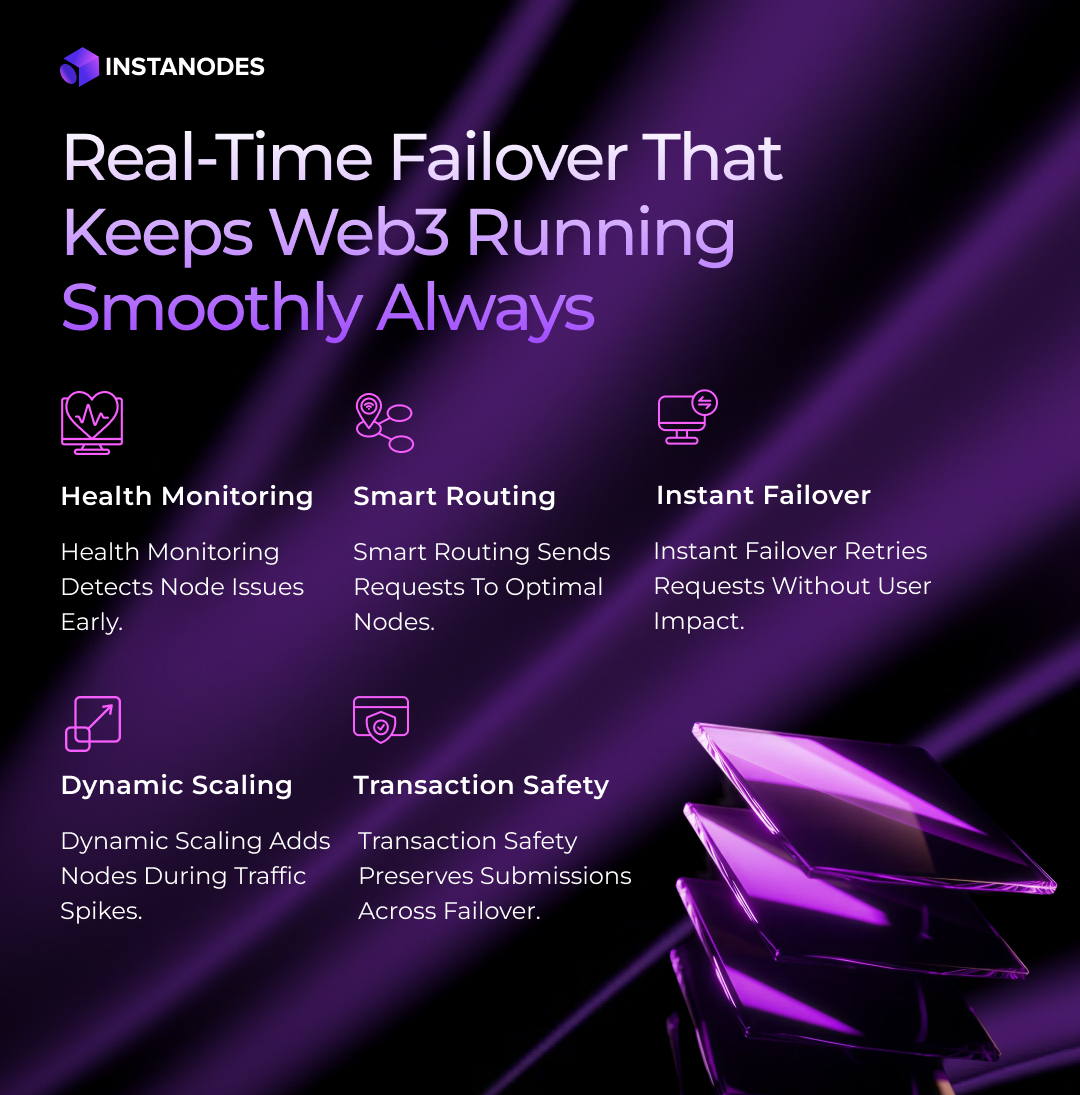
Professional node networks run on constant surveillance. Every blockchain node undergoes health checks from multiple monitoring systems.
The monitoring evaluates:
- Sync status with latest blockchain state.
- Block height matching network consensus.
- Response latency and error rates.
- Resource utilization (CPU, memory, bandwidth).
- Network connectivity to blockchain peers.
These checks run every few seconds, building performance profiles over time. Machine learning algorithms spot patterns invisible to simple threshold alerts. A node’s response time might stay within acceptable limits but gradually increase, a pattern that often signals impending failure.
Advanced Node as a Service platforms catch these early warnings and proactively reduce traffic to affected nodes before users experience problems. The monitoring also goes beyond the individual blockchain nodes, as it monitors gas prices, block production rates, and mempool status, enabling the routing to adjust to the dynamic blockchain environment.
Intelligent Request Routing Makes Real-Time Decisions
When an application makes a request to a blockchain node provider, it reaches an intelligent routing layer that considers a number of factors at once:
- Node health and sync status.
- Geographic proximity to the user.
- Current load and available capacity.
- Historical performance and reliability.
- Request type and requirements.
Different requests get different routing treatment. Current token price queries need the most recently synchronized node. Transaction submissions need excellent blockchain network connectivity. Historical queries route to specialized archive nodes. The routing adds less than 5 milliseconds but automatically sends each request to whichever node can best serve it.
Automatic Failover Happens Transparently
Professional blockchain node providers implement failover through multiple defensive layers:
Layer 1 – Rapid timeout and retry: If a node doesn’t respond within 200-500 milliseconds, the request immediately retries on a different healthy node. The application receives its response without knowing the first attempt failed.
Layer 2 – Node quarantine: For persistent failures, the system removes problematic nodes from rotation within seconds. Traffic routes around failed nodes automatically.
Layer 3 – Automatic recovery: Failed nodes undergo automated diagnosis and resolution. Once passing health checks, they gradually reenter rotation.
The entire process completes without human intervention. Users never experience disruption.
Dynamic Scaling and Transaction Management
Web3 traffic patterns defy prediction. A project might serve baseline traffic for weeks, then explode 100x overnight. Modern Node as a Service platforms monitor aggregate load continuously. When utilization climbs above thresholds, automated systems provision additional blockchain nodes within 5-10 minutes.
Transaction submissions require special handling. Unlike read queries, transactions need exactly-once delivery guarantees. Professional blockchain node providers implement transaction tracking that monitors submissions from initiation through confirmation, preventing duplicate submissions while ensuring nothing gets lost during failover.
API Standardization and Analytics
Different blockchain nodes often have API variations, even when following the same specifications. A leading Web3 node provider abstracts these differences, presenting applications with consistent interfaces. This standardization means code works reliably without special handling for node-specific quirks.
Professional infrastructure includes comprehensive dashboards showing:
- Request volumes and response times.
- Error rates and success metrics.
- Geographic user distribution.
- Endpoint usage analytics.
This visibility transforms infrastructure from a black box into an optimizable component. Developers spot issues before they impact users and proactively improve performance.
Wrapping Up
The shift from 95% to 99.99% uptime is not merely an incremental step in the world of service-level agreements but a paradigm shift in how Web3 applications are providing reliability to their users, who are expecting the same level of always-on functionality that they have come to expect from the traditional web.
Real-time failover, made possible by distributed networks of blockchain nodes, has enabled blockchain infrastructure to reach the level of reliability expected in the enterprise. The technology isn’t theoretical or emerging, it’s proven and available today through professional blockchain node providers who’ve solved the hard problems of distributed systems at scale.
Web3 developers are no longer forced to choose between complexity and reliability. The capital investment, expertise, and maintenance required to run a self-hosted blockchain node are substantial. Single-node systems are still susceptible to the same failure modes that blockchain technology was intended to mitigate. Modern Node as a Service platforms resolve both issues, delivering enterprise reliability without operational burden.
The measurable results speak clearly:
- Downtime reductions exceeding 90%.
- Response time improvements of 75% or more.
- Dynamic capacity scaling that handles unpredictable traffic spikes.
- Geographic distribution that serves global users with local latency.
- Consistent performance during network congestion that breaks single-node setups.
More importantly, these improvements translate directly to user experience. Applications feel responsive and reliable. Transactions go through consistently. Data loads quickly regardless of user location. The infrastructure is rendered invisible in the best possible way, users simply don’t think about it because it always works.
Users won’t stand for applications that crash during peak times or become unresponsive when individual nodes go down. The applications that will succeed in the long term will be those that have been designed with reliability from the start, using tried-and-true infrastructure from professional blockchain node providers.
Ready to make downtime a thing of the past and give users the reliability they expect from modern applications?
Instanodes offers enterprise-class node infrastructure with real-time failover, global distribution, and 99.99% uptime guarantees. The blockchain nodes are distributed across multiple continents, ensuring that dApps remain available even when individual nodes go down.
We provide support for all popular blockchains and it takes a few minutes to deploy nodes. Try now!