You must be wondering how it is possible. Here’s why:
- How many users tried to complete a transaction on your platform this week and quietly left?
- How many Solana RPC API calls timed out before your monitoring dashboard even flagged an issue?
- How many trades were delayed, how many NFT mints failed, how many balance checks returned stale data?
Let’s understand how RPC performance impacts business outcomes, how to detect hidden infrastructure leaks, and how switching to the best Solana RPC provider can directly improve retention, uptime, and trust.
Ensure low latency and stability with our optimized Solana RPC node.
What Your Solana RPC Is Actually Responsible For
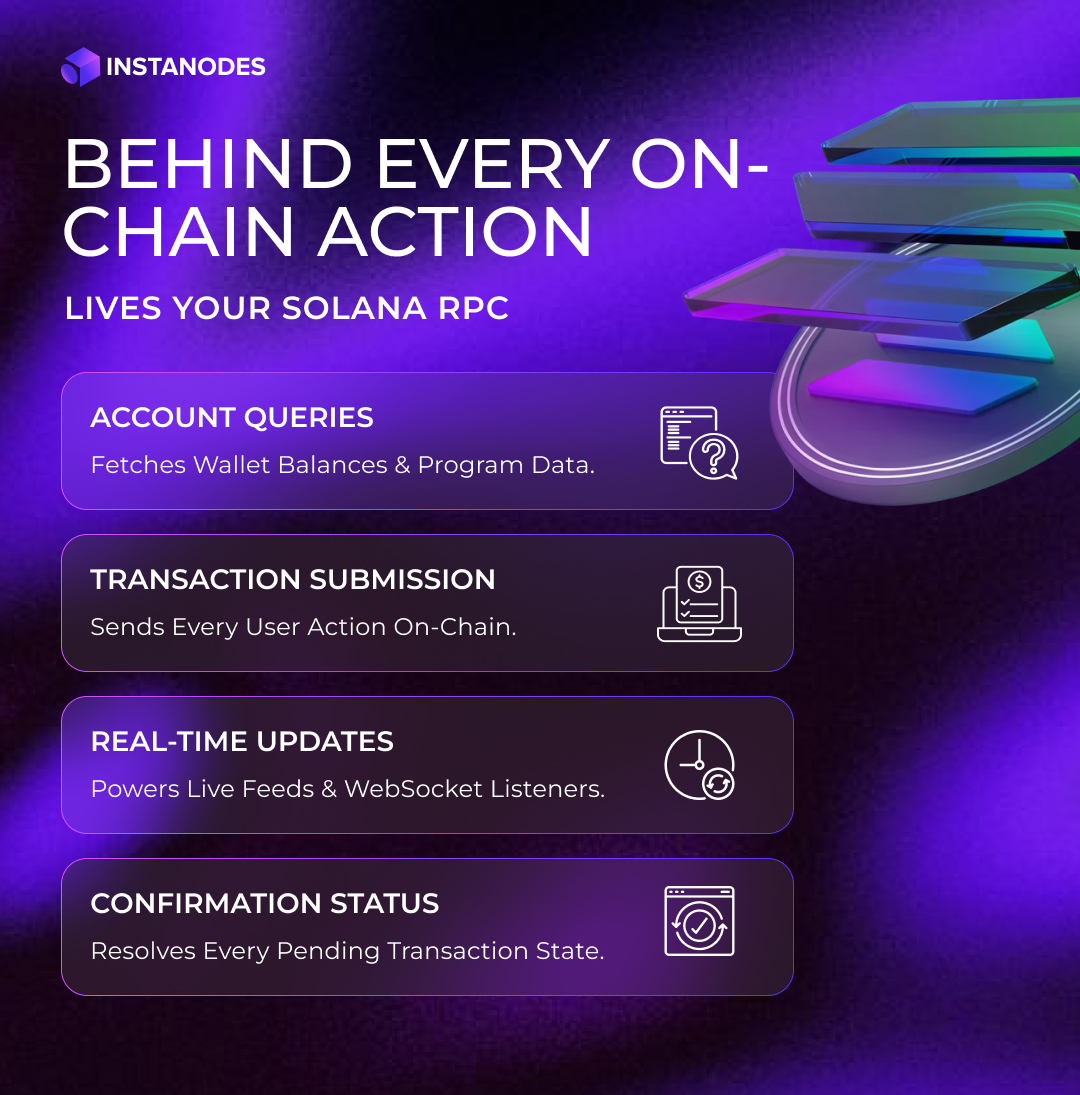
Every single node goes through these processes:
- Processing blockchain state: Each balance query, token lookup, NFT metadata call, and program account query starts with a call to your RPC node.
- Serving transactions: When a user performs a swap, stake, mint, or vote action, this transaction is relayed to the Solana RPC API before reaching the validator network.
- Listening for updates: Your WebSocket subscriptions for real-time data, such as prices, wallet notifications, and on-chain notifications, depend on a solid RPC connection.
- Waiting on confirmation: That spinning loader your user sees while a transaction confirms? It stays spinning until your Solana RPC API comes back with a status update.
Here's why this matters for your business:
- Solana’s value proposition is speed
- Sub-400ms block times.
- Near-instant finality.
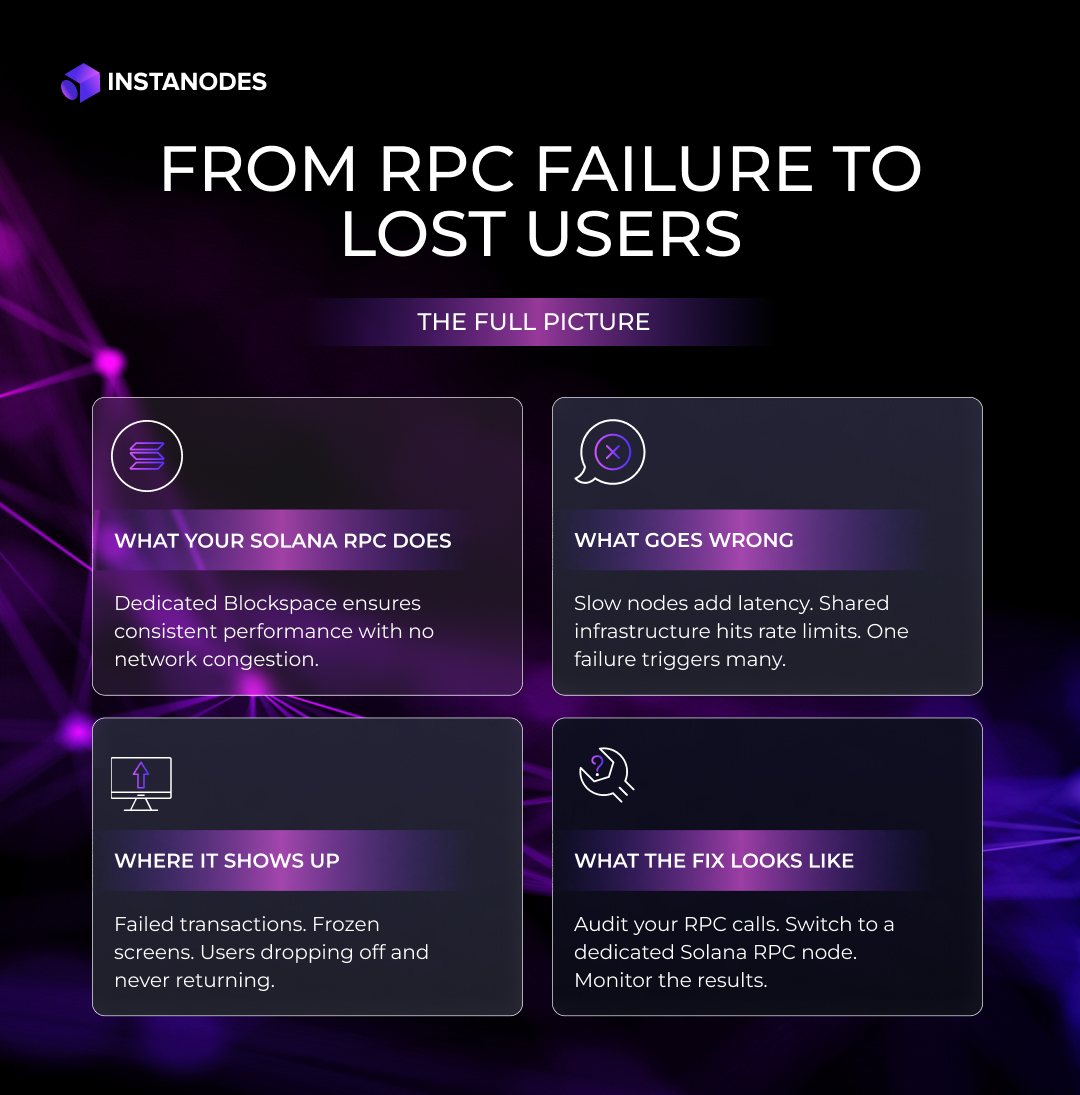
Latency, Rate Limits, and the Cascade of Failures
1. One Bad Call Is All It Takes
2. The Latency Tax
3. The Rate Limit Wall
4. The Cascade Nobody Sees Coming
- A failed getAccountInfo means the UI can’t render the correct state.
- A dropped sendTransaction leaves the user not knowing if their action went through.
- A stale WebSocket connection means the live feed shows outdated data.
- A 429 during a high-traffic moment means a segment of your users gets a broken experience at exactly the time when most of them are active.
How Poor RPC Performance Shows Up in Your Metrics
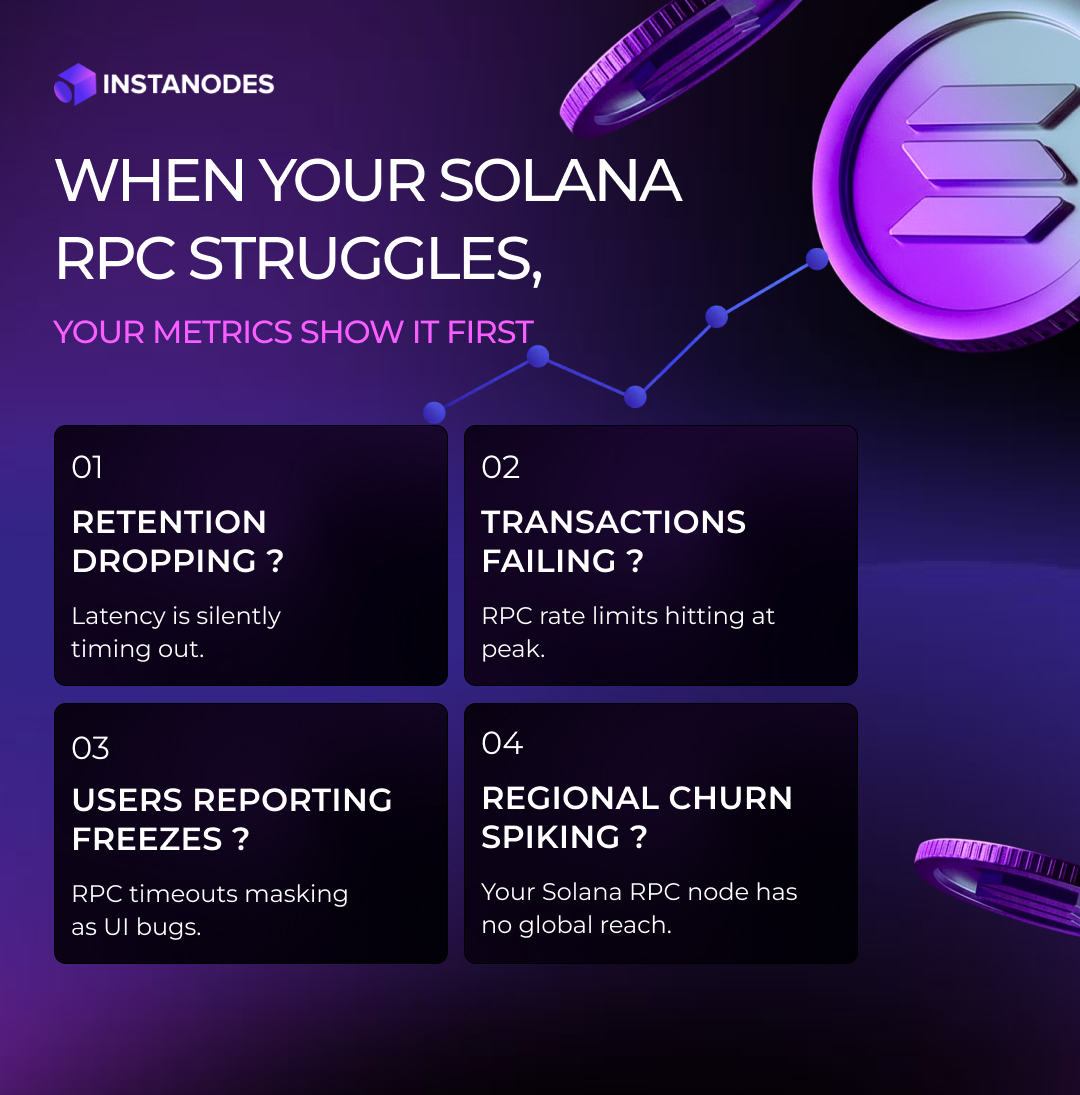
Here’s how to read the signals:
1. Transaction Failure Rates Above 5%
2. Session Drop-offs at Action Points
3. Support Tickets
4. Geographic Performance Gaps
There were no changes in swap logic or smart contracts. It was only the Solana RPC.
Key metrics to start tracking right now:
- Average RPC response time broken down by method: getAccountInfo, sendTransaction, getSignatureStatuses, simulateTransaction.
- RPC error rate categorized by type: 429s, timeouts, connection failures, malformed responses.
- Transaction confirmation latency from submission to finalized status.
- WebSocket uptime and how often your app is silently reconnecting.
Stop revenue leaks caused by slow infrastructure. Upgrade your Solana RPC node now.
Switching RPCs Without Breaking Your App
At this stage, if you are mentally going through your current configuration and are unsure about it, that voice in your head is definitely one you should listen to. Changing your Solana node provider in the middle of your production cycle is like changing tires on a moving car.
Here’s how to do it safely:
1. Audit Before You Touch Anything
2. Get Off Hardcoded URLs
3. Stress Test Before You Go Live
4. Build In a Fallback
5. Watch the First Week Closely
What to look for when evaluating providers:
- Dedicated node infrastructure, not shared capacity with thousands of other developers.
- Global edge presence for consistent low-latency access across user regions.
- Rate limits built for production scale, with burst capacity for traffic spikes.
- Stable WebSocket infrastructure for real-time features.
- Transparent SLAs with historical uptime data, not just marketing claims.
- Full Solana RPC API support including enhanced methods.
- Technical support that actually knows Solana, not just generic cloud support.
Concluding Thoughts
Explore Instanodes’ Solana RPC plans today. Contact us now!