Are you building on Solana? Your infrastructure isn’t just a technical chorus. It’s directly tied to revenue, trust, and growth.
You must be wondering how it is possible. Here’s why:
- How many users tried to complete a transaction on your platform this week and quietly left?
- How many Solana RPC API calls timed out before your monitoring dashboard even flagged an issue?
- How many trades were delayed, how many NFT mints failed, how many balance checks returned stale data?
The problem is neither your smart contracts, nor your UI. Not even your onboarding flow. It’s your RPC.
In B2B environments, which includes custodians, exchanges, wallets, and fintech apps, the difference between a 200ms response and a 1.2s response can mean the difference between a completed transaction and a lost customer. At the center of it all sits your Solana RPC layer.
Many builders are obsessed over frontend UX, tokenomics, and partnerships, but they hardly accept the uncomfortable truth that their Solana RPC node may be the silent reason customers churn.
Let’s understand how RPC performance impacts business outcomes, how to detect hidden infrastructure leaks, and how switching to the best Solana RPC provider can directly improve retention, uptime, and trust.
Continue reading!
Ensure low latency and stability with our optimized Solana RPC node.
Stop revenue leaks caused by slow infrastructure. Upgrade your Solana RPC node now.
What Your Solana RPC Is Actually Responsible For
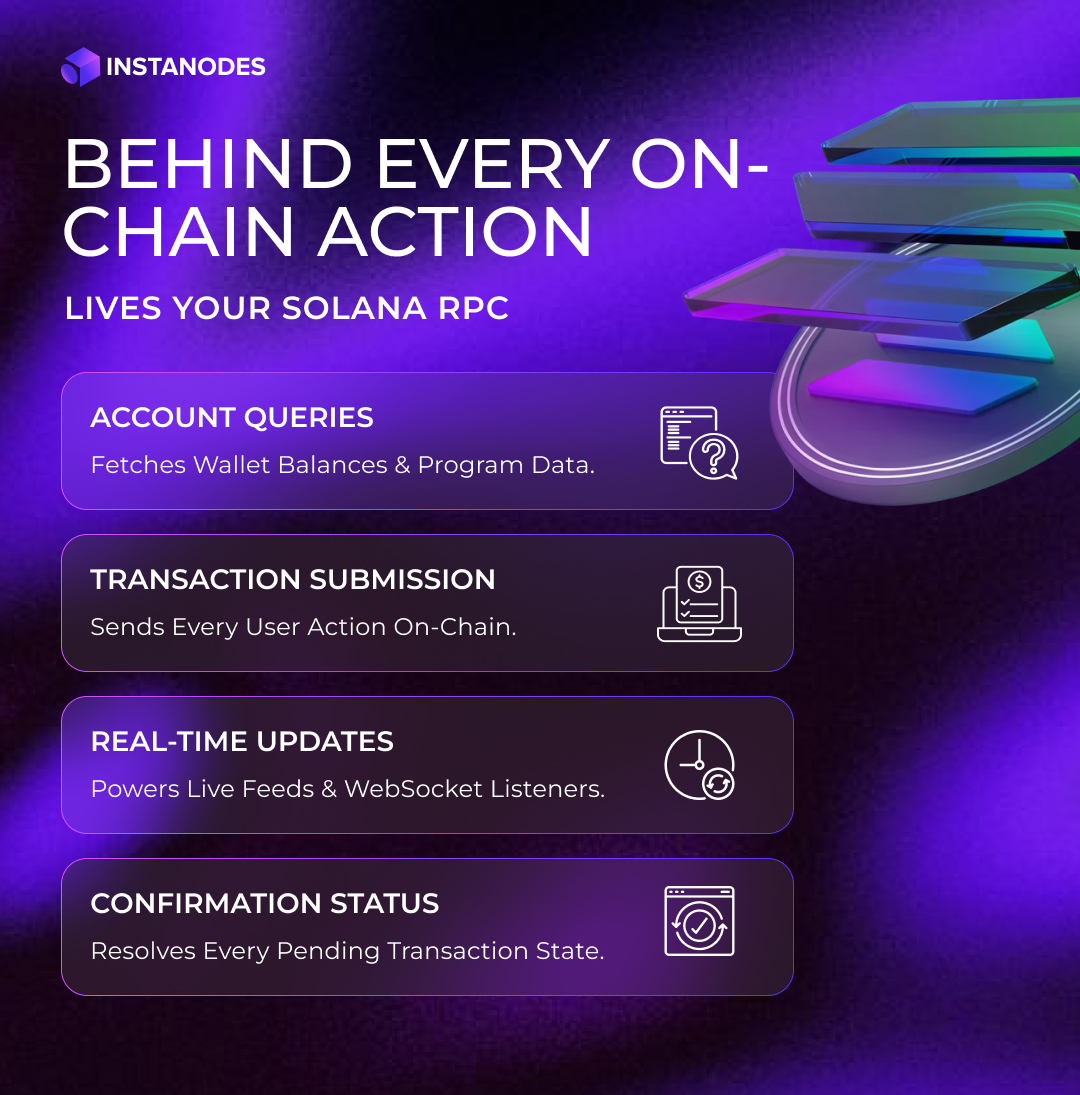
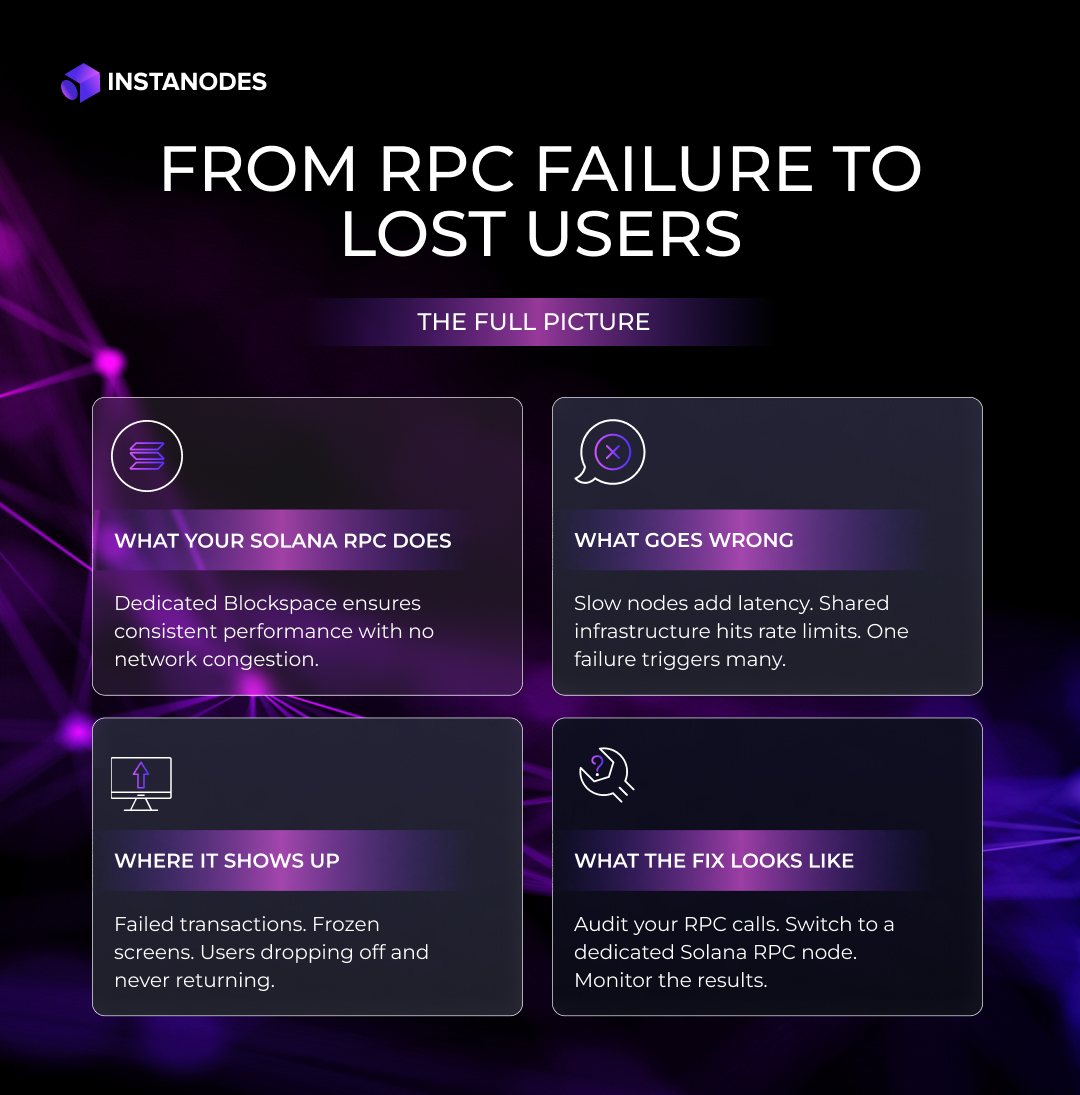
Your Solana node is the silent engine behind every on-chain action. It’s a harsh reality that many developers treat a Solana RPC node the way most people treat their internet router. The truth is that they stay invisible, assumed to work, and only noticed when something breaks. It is needless to say that your Solana RPC is sitting in the middle of every meaningful thing your users do inside your product.
Every single node goes through these processes:
- Processing blockchain state: Each balance query, token lookup, NFT metadata call, and program account query starts with a call to your RPC node.
- Serving transactions: When a user performs a swap, stake, mint, or vote action, this transaction is relayed to the Solana RPC API before reaching the validator network.
- Listening for updates: Your WebSocket subscriptions for real-time data, such as prices, wallet notifications, and on-chain notifications, depend on a solid RPC connection.
- Waiting on confirmation: That spinning loader your user sees while a transaction confirms? It stays spinning until your Solana RPC API comes back with a status update.
Here's why this matters for your business:
- Solana’s value proposition is speed
- Sub-400ms block times.
- Near-instant finality.
Users who come to Solana-based products come with an expectation of snappiness. The moment your app feels slow, it doesn’t feel like a blockchain problem; it feels like your problem, and they’ll hold you accountable for it.
A public or undersized Solana RPC node introduces artificial latency into every one of these interactions. It’s not a technical inconvenience. It’s a product experience problem that shows up directly in retention.
Latency, Rate Limits, and the Cascade of Failures
A slow or rate-limited RPC doesn’t just cause one bad moment — it triggers a chain of failures your users feel immediately.
1. One Bad Call Is All It Takes
The two failure modes that kill Solana apps most often aren’t dramatic. They don’t cause outages or throw errors that make it into your logs. They’re quieter than that and because of that, they’re more dangerous.
2. The Latency Tax
Every call your app makes to the Solana RPC is a round trip. When your RPC node is far from your users, running on shared infrastructure, or operating near capacity, each of those round trips gets slower. And those round trips stack.
A typical user action might require five sequential RPC calls: fetch account data, simulate the transaction, send it, poll for confirmation, then refresh state. At 80ms per call, that’s 400ms, which is fast and invisible. At 400ms per call? It’s a two-second interaction. On a chain known for being instant. It’s the latency tax, and it compounds with every call you add.
3. The Rate Limit Wall
Public Solana RPC endpoints have strict request limits. They have to, as they’re serving thousands of developers simultaneously on shared infrastructure. As long as your traffic is small, you’re within the limits, and everything seems great. As soon as you experience a traffic spike, such as a product launch or a token drop, these limits are quickly reached.
When the Solana RPC API starts returning 429 errors, requests don’t fail cleanly. They hang, queue, or time out silently. Users see loading states that never resolve.
A high percentage of Web3 application errors experienced by end users were actually infrastructure-layer failures. There were no bugs, not even bad contracts, just the RPC layer buckling under load.
4. The Cascade Nobody Sees Coming
What makes this particularly damaging is how RPC failures travel through your app. One failed call doesn’t produce one bad outcome, it produces a chain reaction:
- A failed getAccountInfo means the UI can’t render the correct state.
- A dropped sendTransaction leaves the user not knowing if their action went through.
- A stale WebSocket connection means the live feed shows outdated data.
- A 429 during a high-traffic moment means a segment of your users gets a broken experience at exactly the time when most of them are active.
Rate limits hit hardest precisely when you can least afford them: peak usage. Moreover, if you’re relying on a shared Solana RPC node, you’re always one trending moment away from a wall.
Selecting the best Solana RPC provider is more than just an infrastructure box to check. It is a question of how much of your users’ experience you are willing to put in the hands of luck.
How Poor RPC Performance Shows Up in Your Metrics
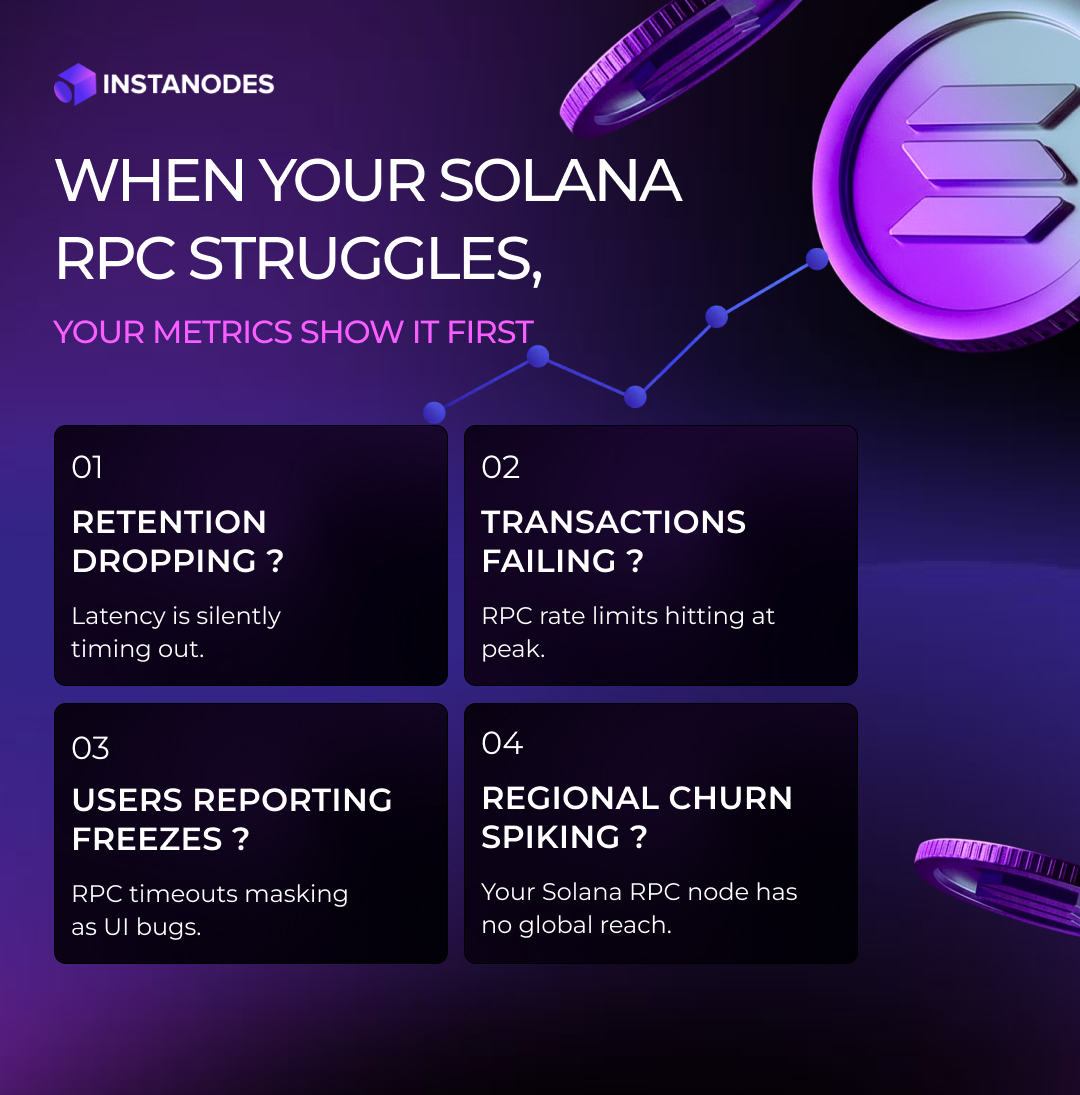
You’re probably misreading the data. The sneaky thing about RPC degradation is that it doesn’t show up with a label on it. It disguises itself as product problems. Developers spend weeks A/B testing onboarding flows or redesigning transaction UIs when the real issue is sitting one layer deeper.
Here’s how to read the signals:
1. Transaction Failure Rates Above 5%
If more than one in twenty transactions initiated in your app doesn’t complete successfully and your contracts are sound. Your Solana RPC node is the first place to look. Failed simulations, dropped submissions, and confirmation timeouts account for the vast majority of on-chain transaction failures that aren’t caused by user error or contract logic.
2. Session Drop-offs at Action Points
Pull your session recordings or funnel data and look at where users stop. If there is a steady drop-off immediately following a user’s initiation of a transaction, a click on a page with heavy loads, or the opening of a feature that requires multiple account fetches. It’s not a UX issue, it’s latency. Users won’t wait if something doesn’t happen in two seconds. They leave.
3. Support Tickets
Is your support team receiving complaints about the frozen app, stuck transitions, or not responding to clicks? These issues almost always trace back to RPC timeouts presenting as UI hangs. These are some of the most avoidable user frustrations in Web3, and they consistently show up when teams are on undersized or shared Solana RPC infrastructure.
4. Geographic Performance Gaps
Pull your session data and filter by region. If users in Southeast Asia, Eastern Europe, or Latin America are churning at rates significantly higher than your core user base and there’s no obvious regional product issue, latency to the Solana RPC node is likely the gap.
An RPC service that operates in a single region can introduce an additional 200-400ms latency for users on the other side of the planet. At which point, every interaction becomes a broken experience.
Let’s face the real-world scenario- A mid-sized DEX operating on the Solana blockchain with 15,000 daily active users experiencing a 22% reduction in the number of successful swaps over a two-week period. After careful instrumentation, the team finds that 78% of the incomplete swaps weren’t failing on-chain at all. They were timing out at the RPC submission layer during peak hours when rate limits were being hit. After switching to a dedicated, geographically distributed Solana RPC node, swap completions recovered above 97% within the week.
There were no changes in swap logic or smart contracts. It was only the Solana RPC.
Key metrics to start tracking right now:
- Average RPC response time broken down by method: getAccountInfo, sendTransaction, getSignatureStatuses, simulateTransaction.
- RPC error rate categorized by type: 429s, timeouts, connection failures, malformed responses.
- Transaction confirmation latency from submission to finalized status.
- WebSocket uptime and how often your app is silently reconnecting.
Switching RPCs Without Breaking Your App
Moving to a better Solana RPC doesn’t have to be a risk. With the right strategy, it’s one of the easiest, most impactful upgrades you’ll ever make.
At this stage, if you are mentally going through your current configuration and are unsure about it, that voice in your head is definitely one you should listen to. Changing your Solana node provider in the middle of your production cycle is like changing tires on a moving car.
Here’s how to do it safely:
1. Audit Before You Touch Anything
The first step is purely observational. Map every place in your codebase that touches the Solana RPC API, including connection instantiation, RPC URL references in environment configs, SDK configurations in backend services, serverless function setups, and any third-party integrations that make their own RPC calls. Don’t change a thing yet. Just build the complete picture.
2. Get Off Hardcoded URLs
If your Solana RPC node URL is hardcoded anywhere in your codebase, it’s a problem to fix before anything else. Every RPC endpoint reference should come from an environment variable. It’s a small change that makes future migrations instantaneous, lets you A/B test providers, and gives you rollback capability in seconds if something goes wrong.
3. Stress Test Before You Go Live
Testing a handful of manual transactions in a staging environment is not sufficient validation. You need to replay realistic traffic patterns against your new Solana RPC provider. Consider concurrent requests, burst load scenarios, WebSocket connections held open over time. The best Solana RPC provider for your product is the one that holds up under your specific usage profile, not just in benchmark conditions.
4. Build In a Fallback
Even after switching to a high-quality Solana RPC node, configuring a secondary fallback endpoint is worth the hour it takes. The @solana/web3.js library supports custom retry configurations, and many RPC providers offer secondary endpoints or load-balanced options. A fallback doesn’t mean your primary is unreliable and it means you’ve thought about what happens when the unexpected occurs.
5. Watch the First Week Closely
After you cut over, treat the first seven days as a monitoring sprint. Track your RPC error rate, transaction success rate, and user session metrics more closely than usual. A good migration to the best Solana RPC provider should quickly demonstrate improvement. It includes lower latency numbers, fewer timeouts, and higher transaction success rates.
What to look for when evaluating providers:
- Dedicated node infrastructure, not shared capacity with thousands of other developers.
- Global edge presence for consistent low-latency access across user regions.
- Rate limits built for production scale, with burst capacity for traffic spikes.
- Stable WebSocket infrastructure for real-time features.
- Transparent SLAs with historical uptime data, not just marketing claims.
- Full Solana RPC API support including enhanced methods.
- Technical support that actually knows Solana, not just generic cloud support.
Concluding Thoughts
RPC degradation doesn’t announce itself. There’s no crash, no alert, no single moment you can point to. It’s a slow, invisible drain on retention that gets misread as a product problem, a marketing problem, or just the cost of building in Web3.
However, it’s also one of the simplest fixes available. You don’t need to rewrite contracts or overhaul your UI. You just need to stop treating your Solana RPC as background infrastructure.
The enterprises building reliable, fast experiences on Solana made one decision differently. Make sure your infrastructure keeps up.
Instanodes provides dedicated, high-performance Solana RPC node infrastructure with global edge deployment, enterprise-grade Solana RPC API access, and SLAs built for production traffic. Stop patching around your infrastructure. Start building on one that holds.
Explore Instanodes’ Solana RPC plans today. Contact us now!